

There is always a new AI integration, a new workflow, or a new acronym to figure out. For many leaders, it feels like trying to hit a fast-moving target. As one speaker put it, the challenge is not only learning faster, it is also unlearning the habits we have relied on for years.
That theme shaped a recent virtual roundtable hosted by ExecOnline and Udemy. Senior leaders came together to talk honestly about what AI transformation really looks like inside their organizations. In between the discussion, master sommelier Jennifer Foucher guided a wine tasting that became an unexpected metaphor. A great wine experience depends on context, balance, and thoughtful pairing. Bringing AI into an organization works the same way.
What followed was a candid and practical conversation about how AI is reshaping our thinking, our workplaces, and the way leaders show up.
Trend 1: From Learning More to Unlearning Faster
Udemy’s Chief Skills and Learning Officer, Sarah Healy, shared a simple idea: the real competitive advantage ahead is not knowledge. It is neuroflexibility.
Technology is not just changing what people do. It is changing how their brains operate. We are outsourcing memory, reasoning, and even parts of creativity to tools. Leaders now have to help their teams unlearn outdated patterns and get comfortable reframing how they think.
This shift is not only a process change. It is a biological one. Organizations that make space for experimenting, rethinking, and course-correcting will move faster and with more confidence.
Trend 2: From Knowing to Doing
Traditional learning was built around content. Today, performance depends on application.
Sarah shared research showing that people forget about half of what they learn within a day if they do not use it. Real skill building happens through practice. Labs, role plays, and simulations help people remap neural pathways and build muscle memory.
AI can make this easier. Instead of asking people to step away from work to learn, AI tools can weave learning into everyday tasks. Leaders now want experiences that are practical, quick, and integrated into the flow of work rather than separate from it.
Trend 3: Designing for the Distracted Brain
The third shift centers on attention. Employees are operating in what Sarah described as a neuro battle on focus. Expectations for learning have changed.
People want learning that
● Feels as intuitive as Netflix
● Sounds as personalized as Spotify
● Competes for attention the way TikTok does
Gen Z will soon make up a large share of the workforce, and their attention has been shaped by micro content and constant stimuli. That has real implications for learning design. Microlearning is proving far more engaging than traditional approaches, especially when content is short, focused, and sequenced thoughtfully.
Instead of fighting shorter attention spans, the group explored how to work with them. Habits, interactivity, emotion, and small bursts of content bring people back in and help them rebuild skills in new ways.
Why Leadership Matters More Than Ever
These trends all point back to leadership. The leaders who thrive will be those who communicate clearly through uncertainty, show emotional intelligence when pressure rises, and create psychological safety so people feel comfortable experimenting with AI.
Very few leaders today believe their workforce is prepared for the future. That gap makes leadership the deciding factor. AI will not transform organizations on its own. Leaders and teams who know how to harness it will.
ExecOnline’s COO, Matt Castaldo, shared a framework for the capabilities leaders need now:
● Strategic leadership
● Operational leadership
● People leadership
● Self leadership
In the past, leaders could excel in one area and still succeed. Today, they need competence across all four. Real transformation happens in the overlap where leaders align people around a vision, plan thoughtfully, and build cross-functional teams that can execute at speed.
Inside the Group Discussion: What Leaders Are Trying, Fearing, and Learning
When the conversation opened to the group, leaders shared what AI transformation looks like in practice.
Common themes appeared:
● Teams are excited but overwhelmed by the pace of change.
● Some employees quietly wonder if AI will replace their roles.
● Previous transformations have left people tired.
● In some pockets, information hoarding is showing up as self-protection.
One leader described trying to insert AI into existing roles, only to realize the roles themselves were not built for it. The breakthrough came when they broke roles into smaller tasks, identified where AI could add value, and rebuilt roles based on what remained.
Another leader talked about painting a compelling destination. Instead of listing tools, they described how work could feel: less repetitive, more meaningful, more creative. That emotional framing helped teams embrace change instead of fear it.
Others shared how they are normalizing AI by
● Hosting internal sessions to share quick wins
● Creating councils that talk openly about failures
● Encouraging grassroots experimentation
● Surveying employees regularly and adjusting communication based on what they hear
A key takeaway emerged. People often expect AI to be perfect. Leaders found they needed to reset that expectation. AI might get you 50 or 60 percent of the way. Human work is judgment, refinement, and context.
Sarah highlighted that judgment itself is becoming a core skill. People need to know when to trust AI, when to challenge it, and when to rely entirely on human thinking.
Psychological Safety, Change Fatigue, and the Science of Change
The group also explored why change can feel exhausting. One leader noted research showing that the brain responds to change in ways similar to physical pain. Change requires more energy from the brain, which is why routine feels so comforting.
Understanding this helped leaders create more supportive environments. Celebrating small wins, normalizing failure, and addressing fears openly keep people engaged even when the process feels difficult.
Some practical tactics included
● Bringing skeptics into pilots
● Tailoring messages to different job groups
● Clarifying that while tasks may shift, new opportunities are emerging
● Using AI to augment work, like coding agents that act as virtual teammates
Leaders also acknowledged external noise. Headlines about layoffs and automation shape how employees feel, even when those headlines do not reflect what is happening internally.
Wine as a Metaphor for Leadership
Throughout the session, Jennifer Foucher’s wine commentary added a lighter note and a helpful analogy. As she guided participants through a Cabernet from Sonoma and talked about structure, balance, and pairing, a parallel emerged.
Choosing and enjoying wine well is not about memorizing rules. It is about understanding context, staying curious, and asking for support when you need it. AI transformation works the same way. Leaders do not need to be experts in every tool. They need to ask good questions, match the right capabilities to the right problems, and support their teams as they experiment.
Her closing advice on wine applies just as well to AI: be clear about what you want, know your boundaries, ask for guidance when you need it, and remember that you are worth investing in.
What This All Adds Up To
As the session wrapped, moderators brought the themes together.
Change is not slowing down. Learning is becoming a true competitive differentiator. The speed at which leaders and teams adapt will determine who thrives.
The leaders who make the biggest impact will be the ones who can
● Paint a compelling destination
● Align teams around a shared strategy
● Plan realistically and thoughtfully
● Build cross-functional teams that can execute
● Create psychological safety for experimentation and growth
AI will continue to evolve. The real transformation will come from humans who combine adaptability, clarity, empathy, and courage with the tools in front of them.
That is where the group landed. The future of work is not only about AI. It is about how leaders show up and guide people through the very human experience of change.
–
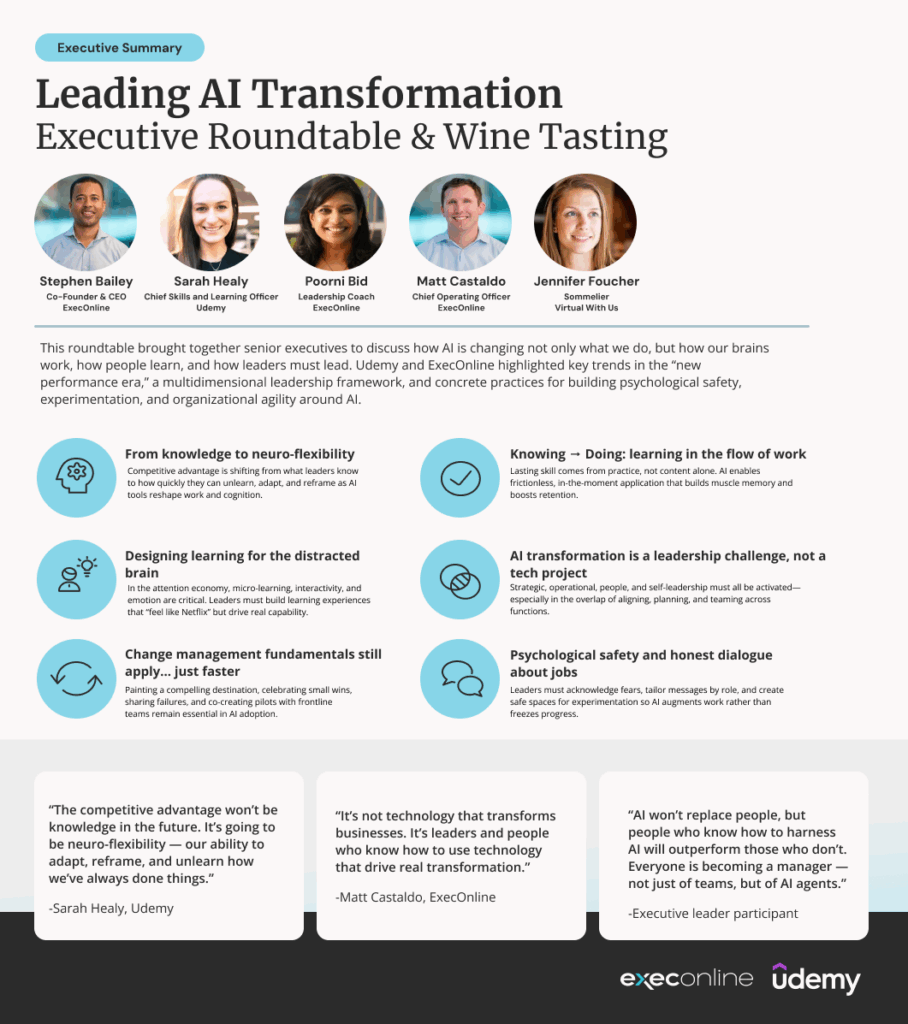
Executive Summary at a Glance
Here’s a visual snapshot of the key themes and leadership insights shared during the ExecOnline and Udemy roundtable:
–
Further Reading and Resources
● The GenAI Transformation: Perspectives on Leadership – Udemy Survey Report
● How Trailblazing Leaders Are Transforming Their Workforce – Russell Reynolds
● ExecOnline Website
● Udemy Business Website